
AICTE Model Curriculum — which book covers which course
The national model every AICTE-approved college builds its syllabus from.
AICTE publishes a national Model Curriculum that every AICTE-approved engineering college adapts into its own syllabus — so RGPV, AKTU, JNTU, VTU, Anna University and the rest all build their B.Tech CSE (AI) mathematics courses from the same template. The topics, credits and module structure are national.
Our books are written to that national model, which is why they serve students at AICTE-approved colleges across the country. Below we take the AICTE model curriculum for the two Computer Science (AI) branches — Artificial Intelligence & Data Science (AI&DS) and Artificial Intelligence & Machine Learning (AI&ML) — course by course, and map each one to the titles in our range that cover it. Where a topic sits outside our range, we say so plainly.
B.Tech CSE — Artificial Intelligence & Data Science (AI&DS)
The AI&DS mathematics spine runs across the first two years: two calculus-and-algebra foundation courses, a dedicated probability & statistics course, and a statistical-computing course.
Mathematics-I
4 credits (3L : 1T : 0P) · MT — Basic Science / Mathematics · Semester 1
- Calculus — evolutes & involutes, definite & improper integrals, Beta & Gamma functions, surface areas & volumes of revolution, Rolle’s / Mean-Value / Taylor’s & Maclaurin theorems, L’Hospital’s rule, maxima & minima
- Sequences & Series — convergence, power series, Taylor’s series, Fourier series (half-range sine & cosine), Parseval’s theorem
- Multivariable Calculus (differentiation) — limits, continuity & partial derivatives, directional & total derivatives, tangent plane & normal, maxima–minima & saddle points, Lagrange multipliers, gradient, curl & divergence
- Matrices — rank & rank-nullity, systems of linear equations, symmetric / skew-symmetric / orthogonal matrices, determinants, eigenvalues & eigenvectors, diagonalization, Cayley–Hamilton theorem, orthogonal transformation
Mathematics-II — Mathematical Foundation of Data Science
4 credits (3L : 1T : 0P) · BS — Basic Science · Semester 2
- Complex Analysis — analytic functions, Cauchy–Riemann equations, harmonic functions, Taylor / Maclaurin / Laurent series, zeros & poles, residue theorems
- Difference Equations & Chaos — recursion & iteration, first- & second-order difference equations, generating functions, logistic equation / logistic map
- Transfer Functions & Dynamical Systems — first- & second-order differential equations, systems of ODEs, Laplace transforms, transfer & impulse functions, frequency response
- Game Theory — strategic games, Nash equilibrium, mixed strategy, auctions
Mathematics-III — Probability & Statistics
3 credits (3L : 0T : 0P) · BS — Basic Science
- Probability — probability spaces, conditional probability, Bayes’ theorem, random variables & distribution functions, joint distributions & independence, expectation, Chebyshev’s inequality
- Special Distributions — binomial, hypergeometric, Poisson, exponential, uniform and normal distributions
- Sampling & Limit Theorems — random sampling, sample mean & variance, weak law of large numbers, central limit theorem
- Statistical Inference — parameter estimation, maximum likelihood, confidence intervals, testing of hypotheses, goodness of fit, non-parametric tests, correlation analysis
Statistical Analysis & Computing
4 credits (3L : 0T : 2P) · PC — Professional Core
- Statistical foundations — probability & statistics review, statistical measures & tests
- Regression & inference — linear & polynomial regression, hypothesis testing
- Resampling — resampling techniques & bootstrapping
- Computing lab — statistical analysis in R, Python and MATLAB; contemporary statistical packages
B.Tech CSE — Artificial Intelligence & Machine Learning (AI&ML)
The AI&ML mathematics spine pairs two calculus-and-algebra foundation courses with Discrete Mathematical Structures — the logic, combinatorics and graph theory that underpins computer science.
Mathematics-I
4 credits (3L : 1T : 0P) · BS — Basic Science · Semester 1
- Linear Algebra — vector spaces, subspaces, basis & dimension, linear transformations & their matrices, linear functionals & adjoints, canonical forms, bilinear & symmetric/skew-symmetric forms
- Calculus — continuity & differentiability of single-variable functions, Rolle’s & Lagrange’s mean-value theorems, double & triple integrals, change of variables
- Vector Calculus — line integrals, Green’s theorem, path independence, surface integrals, Stokes’ theorem, Gauss divergence theorem
- Differential Equations — first-order linear & Bernoulli equations, exact equations & integrating factors, higher-order linear ODEs with constant coefficients
- Multivariate Calculus — definite integrals as limits of sums, area / volume / surface area, improper integrals, functions of several variables, mixed partials, local maxima–minima, Lagrange multipliers
Mathematics-II
4 credits (3L : 1T : 0P) · BS — Basic Science · Semester 2
- Sequences & Series — limits of sequences, monotone & Cauchy sequences, tests for convergence & divergence, integral test, alternating series & Leibnitz test
- Functional Series — pointwise & uniform convergence, power series, Fourier series
- Mathematical Foundations — statements & quantifiers, operations on sets & functions, relations, proofs
- Number System — countability, transcendental numbers & Liouville’s number, construction of the reals via Cauchy sequences, Fermat’s little theorem & Miller–Rabin primality, Wilson’s & primitive-root theorems
- Probability — sample spaces & events, conditional probability, random variables & distribution functions, moments, Chebyshev inequality, special distributions, law of large numbers
Discrete Mathematical Structures
3 credits (3L : 1T : 0P) · PC — Professional Core
- Mathematical Reasoning — propositions, negation/conjunction/disjunction, implication & equivalence, truth tables, predicates & quantifiers, rules of inference, methods of proof, resolution principle
- Set Theory — inductive definition & proof by induction, Peano postulates, relations & their properties, equivalence relations & partitions, partial orderings & posets
- Combinatorics & Functions — elementary combinatorics & counting, recurrence relations, generating functions, injections/surjections & composition, pigeonhole principle
- Graph Theory — Euler & Hamiltonian graphs, trees & tree traversals, spanning trees, representation of relations by graphs
- Algebraic Structures & Discrete Probability — groups, semigroups & monoids, rings, fields, vector spaces & lattices, discrete random variables
Every title in the AICTE map
Affordable, Indian-authored and written to the AICTE model curriculum — so they serve students at any AICTE-approved university, whatever the name on the university sheet.
Engineering Mathematics-I
View details
Engineering Mathematics-II
View details
Engineering Mathematics-III
View details
Probability & Statistics for Data Science
View details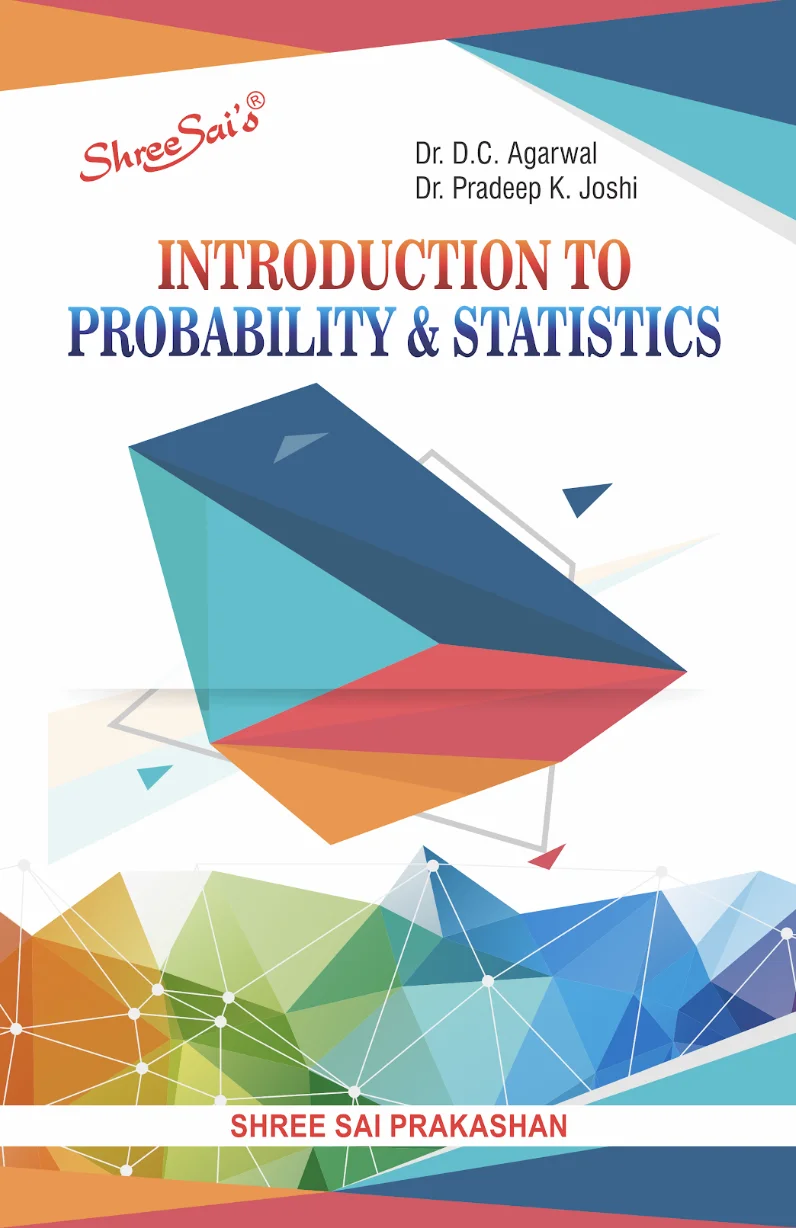
Introduction to Probability & Statistics
View details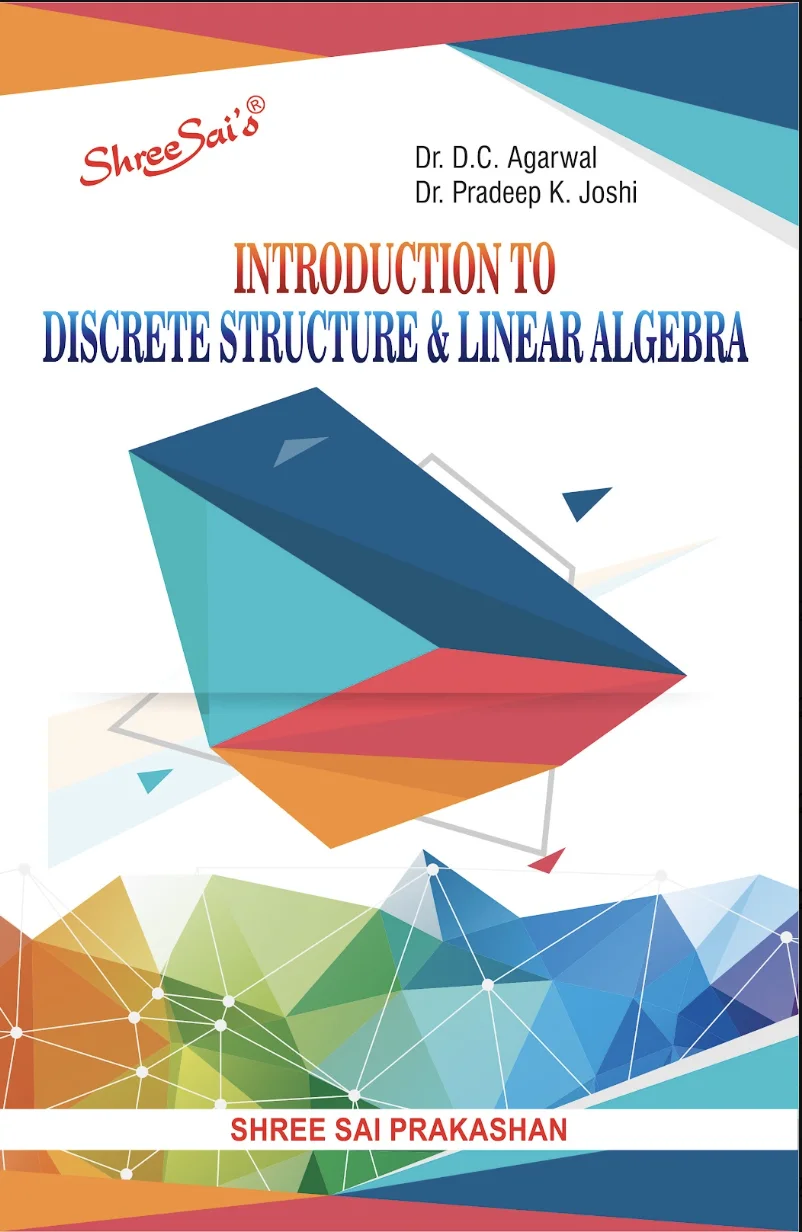
Introduction to Discrete Structure & Linear Algebra
View details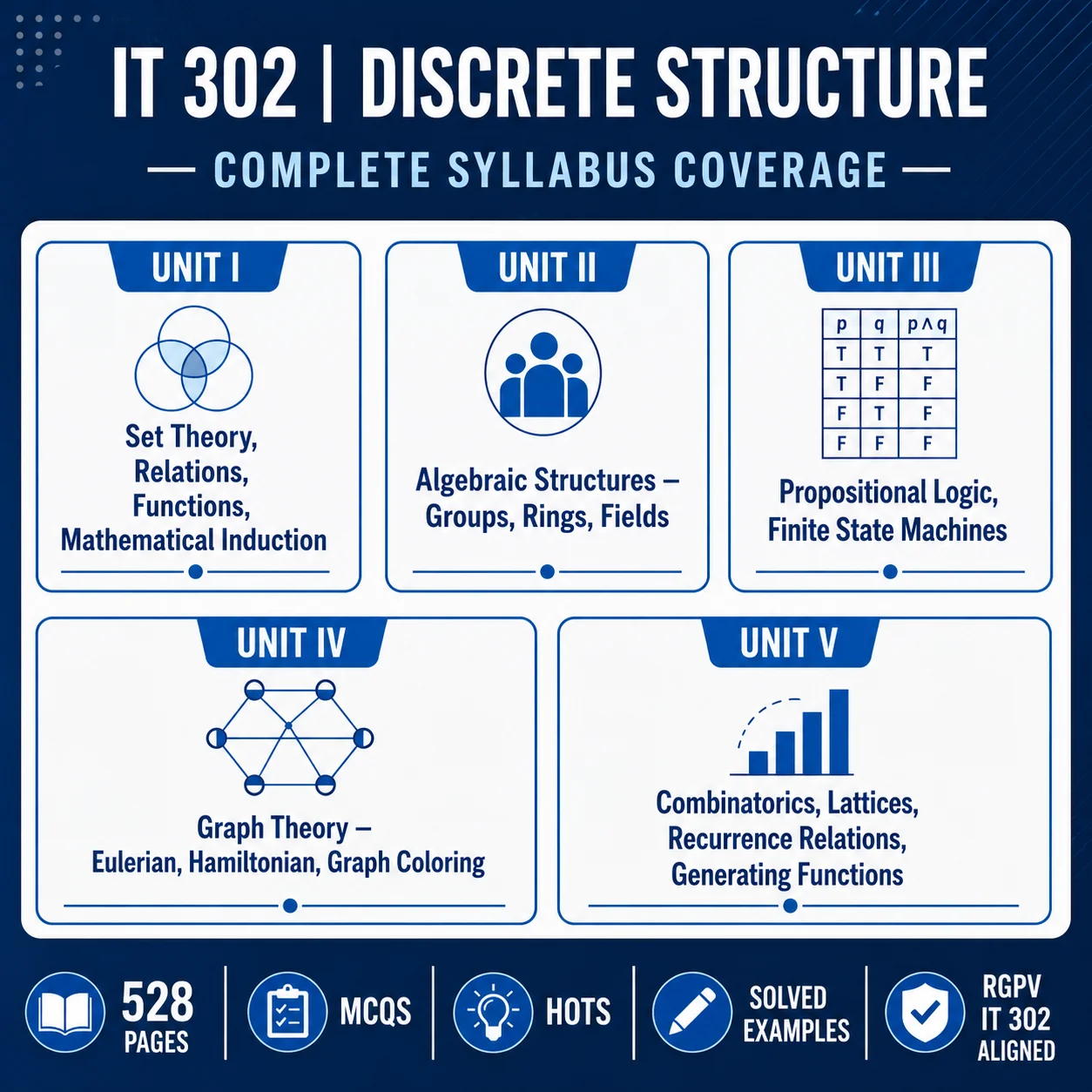
Discrete Structure
View details